
Downspout installation and drainage services in Jackson, MI
A gutter only collects water. The downspout decides where it ends up.
On a lot of Jackson houses, the gutters are fine and the basement still gets wet, because the downspouts empty right against the foundation or there aren't enough of them for the roof. Our downspout installation service fixes both: where the water goes and how much the downspouts can carry.
Roof water should leave the downspout and land at least 4 to 6 feet from the foundation, on ground that slopes away from the house. Most homes also need one downspout for roughly every 30 to 40 feet of gutter, and more where roof valleys concentrate the flow.
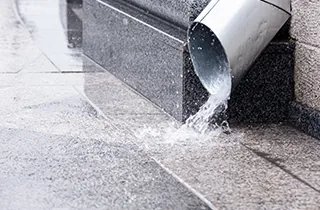
Signs your downspouts are the problem
- A wet basement wall, damp corner or efflorescence (white powder) on the concrete under one downspout.
- A trench or bare patch in the mulch where the downspout empties.
- Water overflowing the gutter right at the outlet, even when the gutter is clean.
- Downspouts that gurgle and back up, or that you have to unclog every fall.
- Ice sheets on a driveway or walkway below a downspout in winter.
- A sump pump that runs constantly after rain.
- Downspouts disconnected, crushed at the bottom, or swinging loose from their straps.
How Jackson's clay soil turns short downspouts into basement leaks
Much of Jackson County is dense clay and silty clay loam. Sandy soil drains a downpour in hours.
Clay can stay saturated for days. A typical roof sheds hundreds of gallons in an inch of rain, and a downspout delivers that from one corner of the roof to one spot on the ground.
If that spot is next to the foundation, the soil there stays waterlogged and presses against the basement wall. On older homes with block or fieldstone foundations, that water finds its way in.
That's why moving the discharge point is often the cheapest effective fix for a wet basement here. A downspout extension that carries the water several feet out, onto ground that falls away from the house, removes the problem at its source. The City of Jackson's stormwater manual also lists disconnecting roof downspouts and letting the water soak in on the property as a recommended practice.
Where water goes matters for code as well. Michigan's plumbing code keeps storm water out of sewer lines built for sewage, so roof water should never be tied into a sanitary drain or a floor drain. If your downspouts disappear into a pipe in the ground and you don't know where that pipe goes, that's worth finding out.
What our downspout and drainage service includes
Adding outlets and downspouts
A long run with one downspout at the far end forces all the water to travel the full length. Adding an outlet in the middle, or at the other end, halves the load. A new outlet is cut into the gutter, sealed, and a downspout is run down the wall to a spot where it can drain.
Upsizing from 2x3 to 3x4 inch downspouts
A 3x4 inch downspout carries far more water than a standard 2x3 and passes leaves and maple seeds that would jam the smaller size. It's the most effective change on homes under trees or with steep roofs. It needs a 6 inch gutter or a large outlet on a 5 inch gutter.
Extensions and splash blocks
Options range from a hinged extension that flips up for mowing, to a fixed run along the ground, to a splash block on ground that already slopes away. Placement decides whether it works. The end should discharge where water keeps moving away from the house, not into a low spot that drains back.
Connecting to underground lines
Some homes have buried drain lines from the downspouts to the yard or curb. If an existing line is clear and goes somewhere appropriate, the downspout can connect to it. If it backs up, it's likely crushed or full of roots, and an above-ground extension is the reliable short-term answer.
Re-strapping and repairing
Loose straps, crushed bottom elbows and separated joints are replaced, and the downspout is fastened so it stays put through frost and snow shoveling.
What affects the cost of downspout installation
- Number of downspouts and their height (1 story or 2).
- Size: 3x4 inch costs more than 2x3 and may need a new outlet or larger gutter.
- New outlets cut into existing gutters.
- Length and type of extensions.
- Obstacles such as patios, driveways or decks where the water has to be carried past.
When drainage becomes an emergency
Call promptly if water is entering the basement during each rain and you can see a downspout dumping at the foundation, if a downspout has come off and the gutter is pouring water against the house, or if a disconnected downspout is sending water across a walkway that freezes at night. As a temporary measure, a spare length of downspout or a roll-out sleeve laid on the ground to carry water away helps until the repair.
What to watch after the work
Walk the house during the next hard rain. Water should leave every downspout freely and move away from the house at each discharge point.
Check that extensions are put back after mowing. If the basement stays wet after drainage is corrected, the cause may be grading, failed drain tile or the foundation itself, and that calls for a waterproofing contractor.
Downspouts are where a gutter system either works or doesn't. Read how we size both together on our page about gutter installation in Jackson, or see how undersized systems are handled in gutter replacement.
Downspout questions
How far should a downspout drain from my house?
At least 4 to 6 feet, and farther in heavy clay soil or where the ground is flat. The end should be on ground that slopes away from the foundation, not into a dip that drains back toward it.
Can I run my downspout into my sump pit or floor drain?
No. Roof water piped into a sump pit just gets pumped out again and overworks the pump. Connecting to a floor drain or sanitary line sends storm water into the sewer, which Michigan's plumbing code prohibits.
How many downspouts does my house need?
As a rule of thumb, one for every 30 to 40 feet of gutter, with extra outlets where valleys concentrate water and at both ends of long runs. Roof size and pitch change the number, so it's worked out when we measure.
Will bigger downspouts stop my gutters from clogging?
They help a lot. Most clogs start at the outlet and the first elbow.
A 3x4 inch downspout passes debris that blocks a 2x3. Guards help further on houses under trees.